- This event has passed.
2026 Symposium – Southern 8ths Farm (Chesterfield, SC)
Date: Saturday, September 12, 2026
Location: Southern 8ths Farm, Chesterfield, SC
- Meeting Time: 9:30 am to 10:00 am Check-In – 10:00 am to 3:40 pm Program
- Location: Meet at the Learning Center (GPS coordinates 34.79584, -80.15313), located behind the horse barns at 305 Lucious Davis Road, Chesterfield, SC 29709. The driveway entrance to the property is located at GPS Coordinates 34.79965, -80.15423 on the south side of Lucious Davis Road.
Featured Presentations:
- “On the Hunt: My Journey Searching for Butterflies” – Jeff Smith
- “Wing Color, Pattern and Mate Attraction” – Carol Boggs – Professor & Director, School of
The Earth, Ocean, & Environment, University of South Carolina - “Surveying Moths in South Carolina: What We Know and What We Don’t Know” –
Brian Scholtens – Professor of Biology, College of Charleston - “Life is Plastic, It’s Fantastic: A Close Look at the Seasonal Variation of the
Southern Dogface” – Hannah Walton – PhD Candidate, Auburn University
Lodging: Lodging can be found in Cheraw. There are camping opportunities available at Cheraw State Park, Sandhills State Forest and Southern 8ths Farm. For Southern 8ths camping, contact David Harper at david@so8ths.com.
Sign-up: Register on this site using the “Register” button above AND filling out and returning the registration form that can be accessed by either clicking on or copying and pasting the following link into your browser of choice – Symposium Registration Form 2026
Additional Butterfly Walks:
- Friday, September 11, from 1:00 pm until 4:00 pm. Southern 8ths Farm, Chesterfield County at 305 Lucious Davis Rd. The GPS coordinates are 34.795945, -80.153197. We will meet at the Learning Center which is at the back of the property just beyond the barn. Follow the entrance road through the property to the back. Restrooms are available. Target species are Southern Skipperling, Common Sootywing and Harvester. Tom Austin will lead.
- Sunday, September 13, from 9:30 am until 2:30 pm. Carolina Sandhills NWR at 23734 U.S. Highway 1, McBee, SC 29101. GPS Coordinates are 34.5044, -80.2249. We will meet in the parking lot at the visitor center. The main entrance is on US Highway 1, about 4 miles northeast of McBee, SC. No restrooms will be available. Target species are Southern Dogface, Yehl Skipper and other fall butterflies. Dave and Marty Kastner will lead.
Make plans now to bring a friend and join us.
Cost and Payment: Cost is $20 per person and can be made by check (contact Marty Kastner at the email address below for instructions) or via PayPal (which possibly includes credit cards) using the following link.
PayPal Link: https://www.paypal.com/ncp/payment/ZC4LFFH2RCZ86
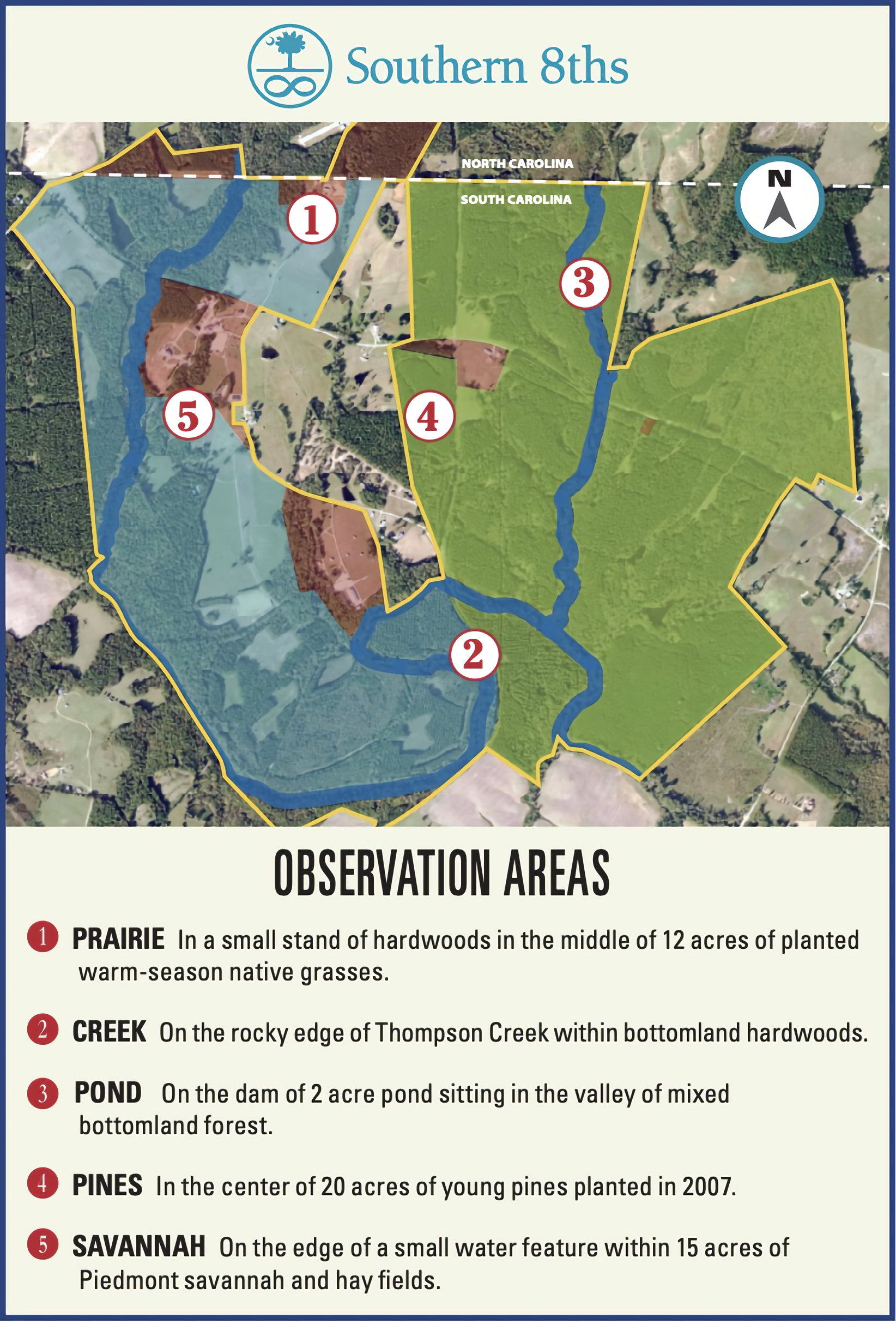
Miscellaneous Information: Southern 8ths Farm is a private conservation property and the home of the Carolina Wildlands Foundation. Southern 8ths Farm is located on the SC/NC border primarily in Chesterfield County, SC with a portion of the property extending into Anson County, NC. The property sits on Thompson Creek in an ecoregional and geological boundary straddling the fall line just above the Sandhills. This unique geology has birthed a rich diversity of native plant communities and Coastal Wildlands Foundation has done extensive work to restore prairie habitat across the property. Southern 8ths is located in an area of convergence, where the Piedmont & Coastal Plain meet along the state line of North and South Carolina. This land is rich in American and natural history and has a history of horses being present since the late 18th century. The geophysical nature of these 1,400 acres of preserved land has encouraged the growth of rolling pastures and fields, diverse upland and bottom land hardwood forests and planted pine stands. The waters of Thompson Creek and its tributaries drop over shale bases to join the Great Pee Dee River and flow to the Atlantic. This land is home to reclaimed grass prairies full of insects and dappled sunlit woodland trails, offering respite to birds, mammals, reptiles, amphibians, and humans. This “corridor of green” is a work-in-progress, and it is teaching us about its future role in the survival of humankind and animal-kind.